Two product challenges. One platform. From broken onboarding to conversion engine.
AI & Experience Strategy Lead for ENSO Co-Living across 4 European markets. Phase 1: redesigned the AI-enhanced onboarding funnel — killed 60% of planned scope, cut friction 22%, lifted booking conversion +34% (validated via A/B test), 4x adoption. Phase 2: built a risk-calibrated urgency system that extended the same decision framework to the catalogue.

Co-living onboarding across 3 markets.
ENSO Co-Living operates in Lisbon, Valencia, Madrid and Barcelona, matching tenants to shared apartments based on lifestyle, language, budget, and timing. When I joined, onboarding was 47 spreadsheets, 3 countries, 3 workflows, zero scalability.
Scope: Onboarding & qualification funnel
Markets: Lisbon, Valencia, Madrid, Barcelona
Work: Research, service design, IA, interface design, design system
Everyone assumed the existing workflow was correct and just needed to move to digital.
Two weeks of operator shadowing proved that wrong. Operators weren't following the spreadsheets. They'd built informal shortcuts. The spreadsheets documented an ideal process. The operators had evolved a real one.
- 47 spreadsheets, 3 countries, 3 different workflows, with no scalability
- The qualification bottleneck was trust, not data. Operators needed to feel confident about a person before showing them rooms
- ~48 hours to first reply. The process gathered data but didn’t answer the trust question
Operators were making 3 decisions per applicant, not 47.
(1) Is this person real? (2) Do they fit an available room? (3) Would they be a good roommate? Everything else was administrative noise accumulated over two years of patching.
Three interventions. Each targeted a specific trust question.
1. Redesigned onboarding as a 5-step funnel answering 3 trust questions
Registration (4 fields, not 14) → Preferences (city, dates, style) → Video intro (1-min self-recorded) → Operator qualification → Personalized room matching

Mobile-first wireframes. Registration → Google flow → Preferences → Video qualification → Success → Room selection.
2. Replaced 12 personality form fields with a single 1-minute video recording
Operators were already doing informal video calls. I formalized and made it async. Video gives more signal in 60 seconds than the entire form.


3. One flow for 3 countries
City-specific logic pushed to room matching step, not registration. One design system, one codebase, one analytics pipeline.
The roadmap had 13 workstreams. I shipped 5. The 8 I killed would have delayed launch by 4+ months and none of them addressed the core trust problem.

What trade-offs did I make?
Every decision involved choosing between digitizing the existing process and redesigning for the real one:
| Decision | Chosen | Rejected | Why |
|---|---|---|---|
| Video intro | 1-min self-recorded video | 12 personality form fields | Operators said video gives more trust signal in 60s than entire form |
| Registration fields | 4 fields (name, DOB, phone, language) | 14 fields | -22% friction at highest drop-off point |
| Multi-country | Single flow, city logic at matching step | Country-specific onboarding flows | One system to maintain, not three |
| Scope | 5 workstreams shipped | 13 workstreams planned | 8 killed items didn’t address core trust problem |
Scope discipline wasn't a constraint. It was the strategy.
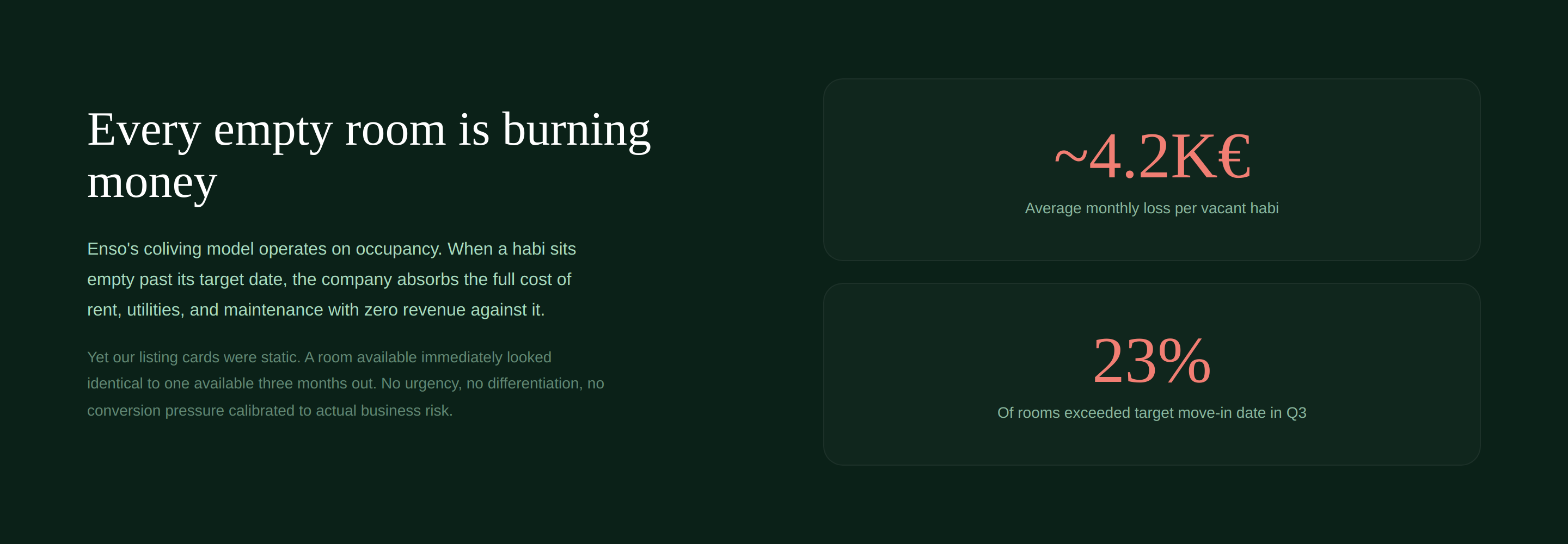
Every empty room is burning money. Static listings weren't helping.
With onboarding solved, the next bottleneck was clear: the catalogue. Every habi costs ENSO ~4.2K€/month when empty. Our listing page treated every room equally. A high-risk vacancy that needed to fill this week looked identical to one available three months out.
No urgency differentiation. No conversion pressure calibrated to actual business risk.
Five risk tiers. Progressive urgency. Ethical by design.
Five risk tiers drive the progressive addition of urgency elements. Each tier maps to days remaining before vacancy becomes a financial liability. The system is additive: higher tiers inherit all elements from lower tiers.
Three design principles: progressive disclosure (start clean), truthful signals (live data, not fabricated), scarcity not pressure (context, not panic).
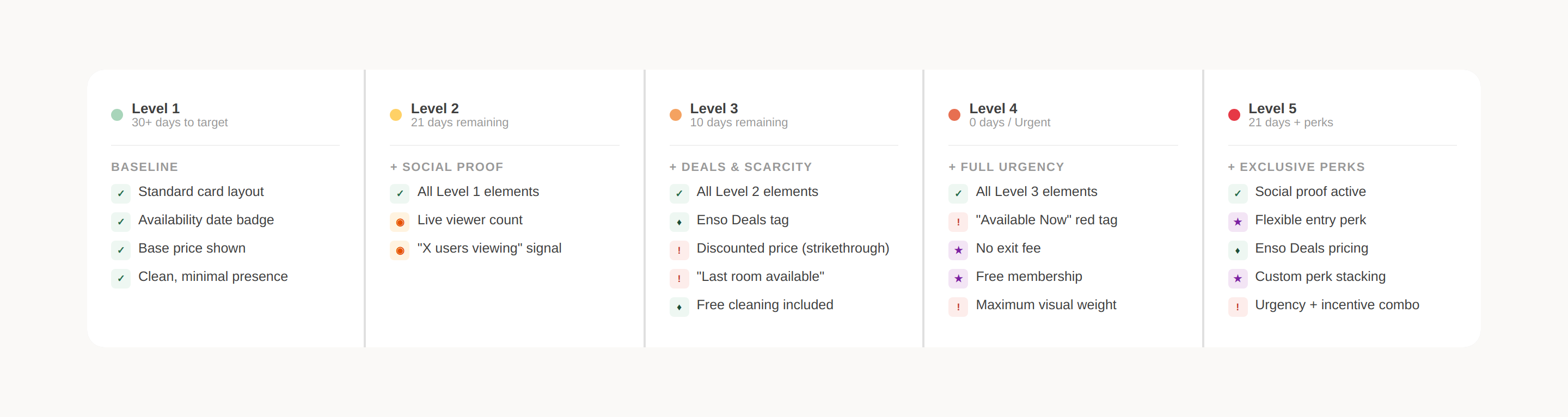
Five risk tiers: from calm (30+ days) to critical (overdue). Each tier progressively activates urgency elements.
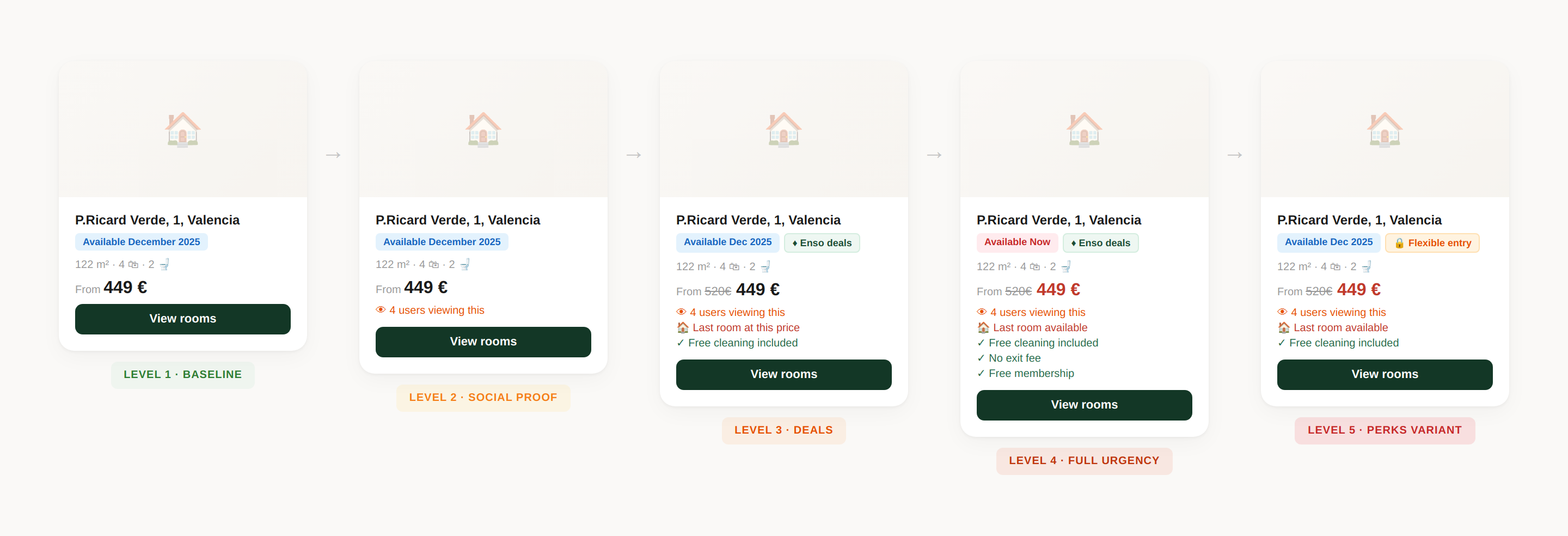
The same room card at each risk tier. Visual density increases only when warranted by actual vacancy risk.
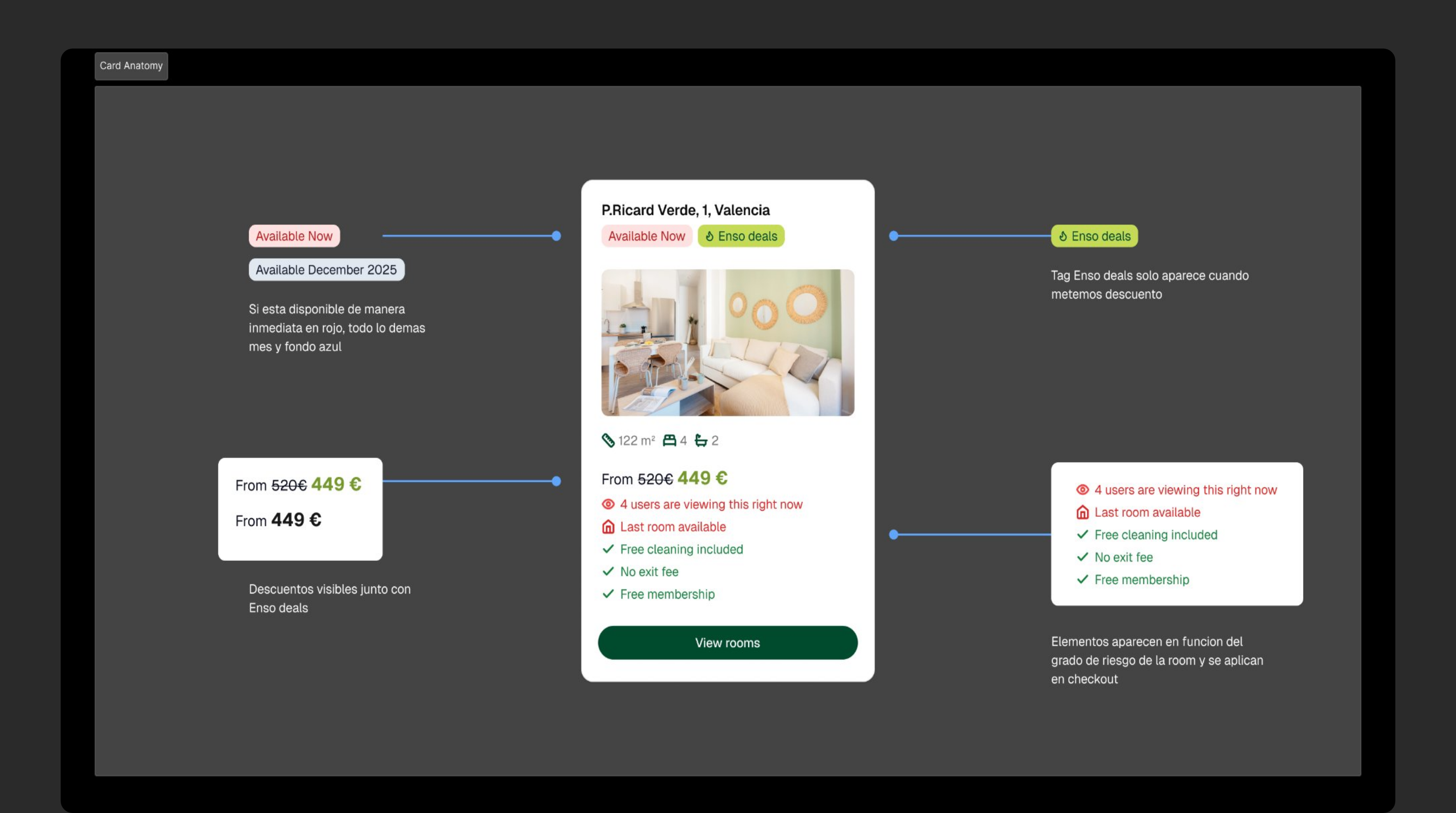
Annotated card anatomy. Every element is conditional, activated by the risk engine.
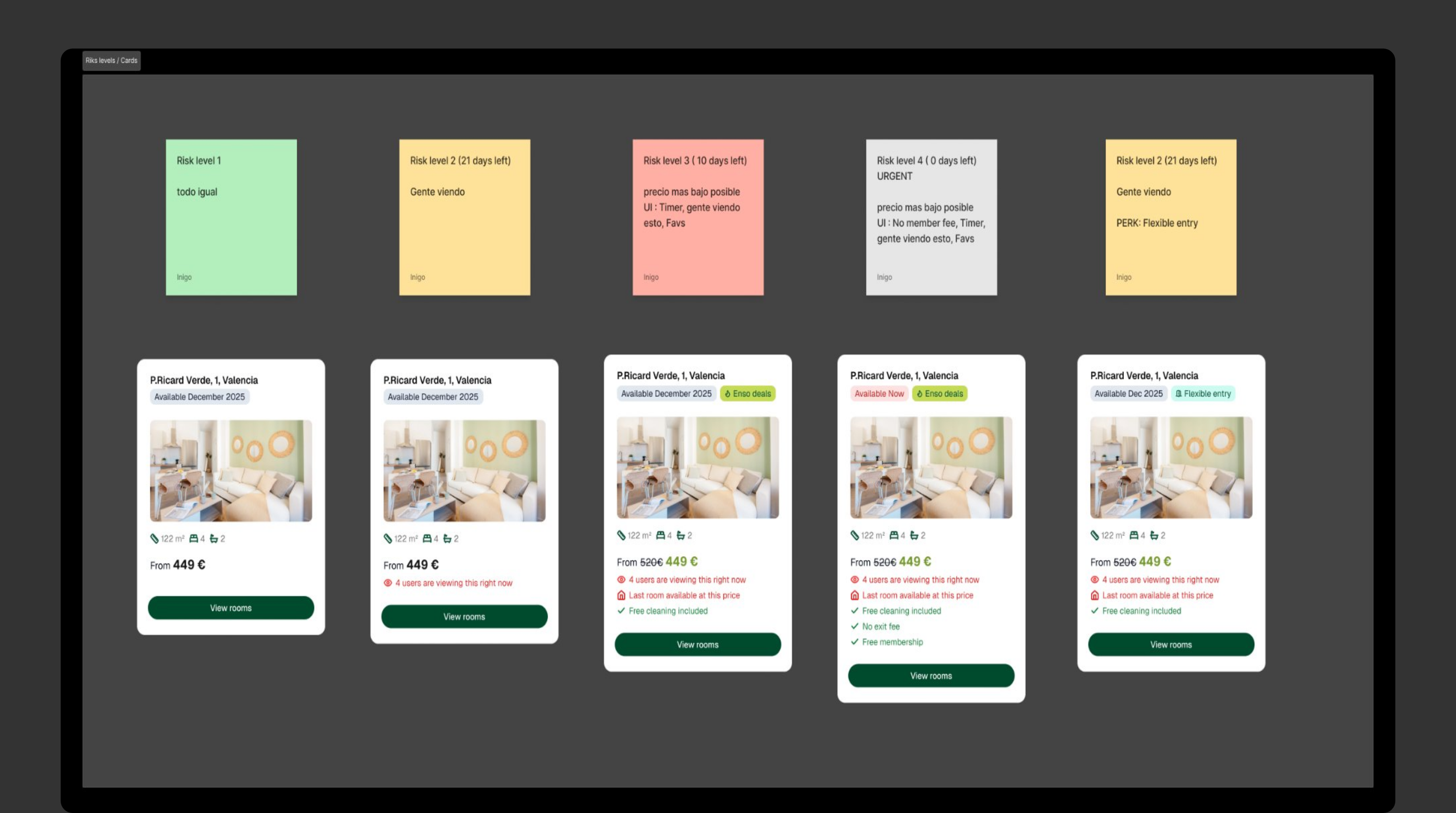
All five risk levels with design rationale. Level 1 is clean and minimal. Level 4 carries the full weight of urgency signals, deals, and perks.
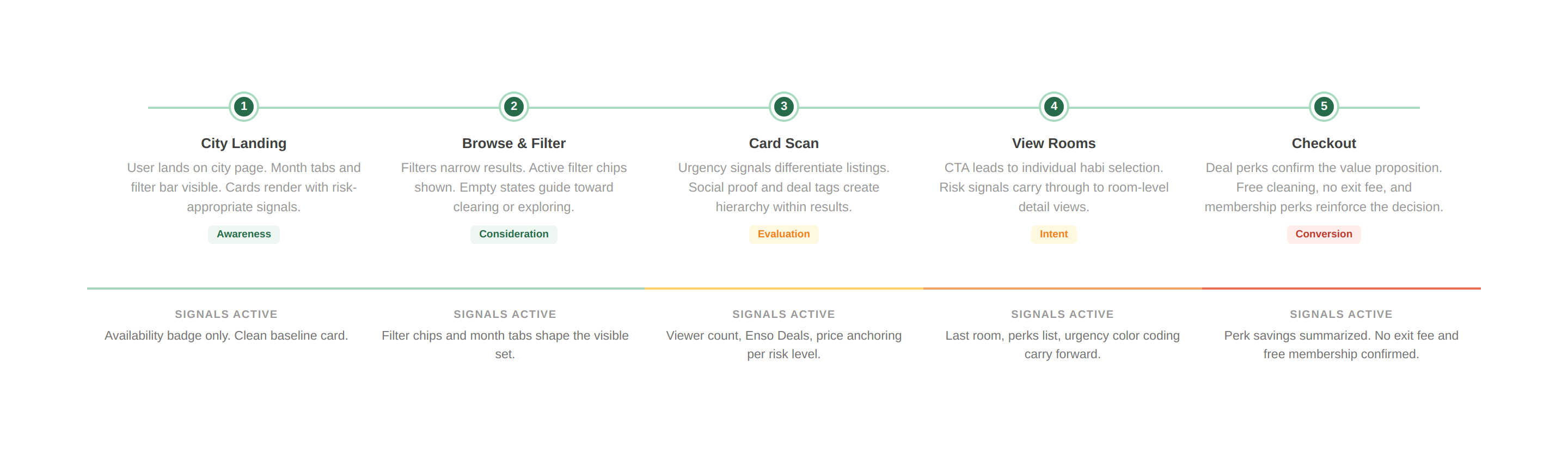
The booking decision flow. From city landing to checkout, urgency signals compound across every step.
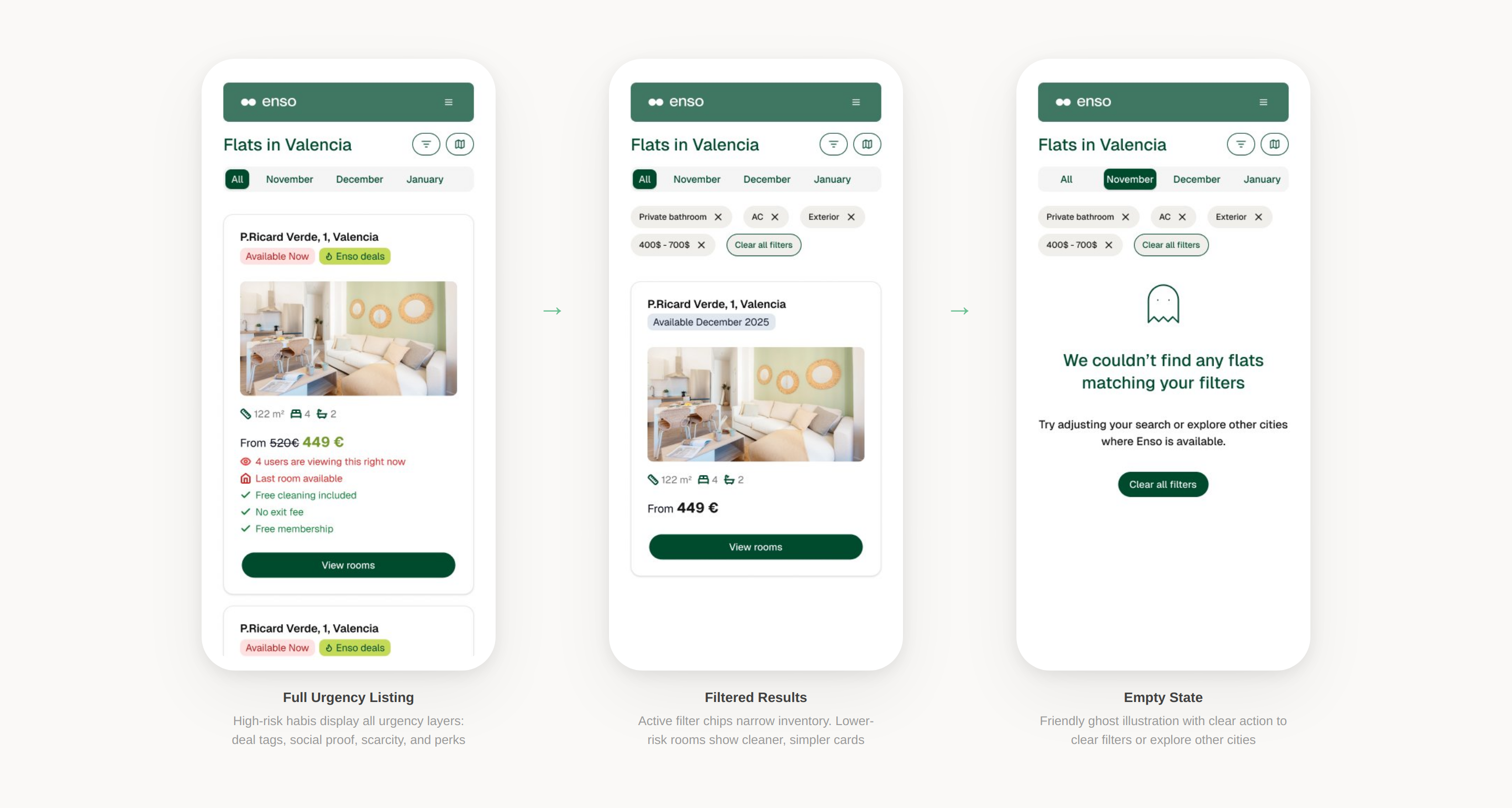
Mobile screens: full urgency listing, filtered results, and empty state handling.
A/B experiment: 14,208 users, 28 days, PostHog.
Controlled experiment. 50/50 split. Variant A (risk-based cards) vs Control (static cards).
Where the uplift compounded
Card click-through was the primary lever (+45.8%), but gains compounded through every step downstream.